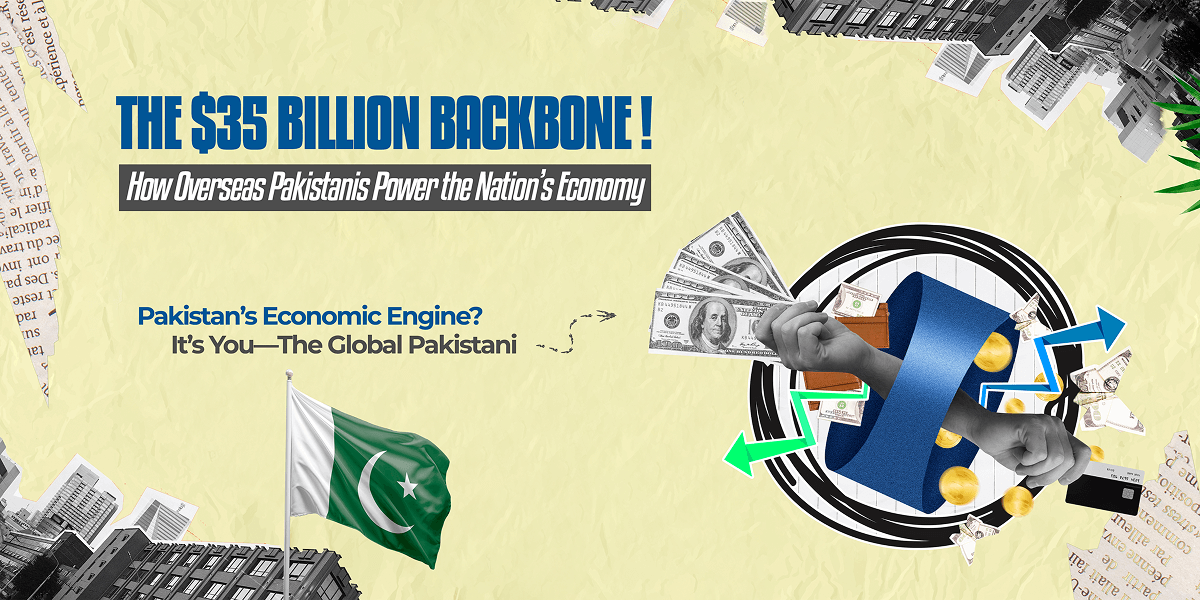

How Overseas Pakistanis Power the Nation’s Economy
Did You Know? $35 Billion Just Supercharged Pakistan’s Economy
Pakistan’s Economic Engine? It’s You—The Global Pakistani
Every year, millions of Pakistanis working abroad send a part of their hard-earned income back home. But these aren’t just acts of personal generosity—they are national catalysts. In May 2025 alone, overseas Pakistanis remitted $3.7 billion—a figure that isn’t just impressive on paper but profoundly transformational in impact. This single-month achievement marked a 16% increase from April and a 13.7% surge compared to the same month last year. Cumulatively, for FY 2025, the remittances stand at an extraordinary $34.9 billion, reinforcing Pakistan’s position among the top global remittance-receiving countries. What this means is simple: overseas Pakistanis are not just sending money home; they are fortifying the pillars of Pakistan’s economy—stabilizing the rupee, funding imports, supporting the current account, and creating room for macroeconomic reform. These inflows help pay for oil, medicine, food, and development projects. They keep inflation in check. And crucially, they keep Pakistan solvent during times of geopolitical instability and local policy fluctuation.
You Might Not See It — But You Are the Backbone
Every month, a quiet yet powerful transfer happens. No red carpets. No big headlines. Just a click from thousands of hardworking Pakistanis living far from home, sending back hope in the form of $2.52 billion a month. And now, it’s official — $34.9 billion has already come in during the first 11 months of FY2025.
According to the State Bank of Pakistan, May 2025 alone saw $3.7 billion in remittances — a 14% rise year-on-year and 16% higher than April. A consistent surge like this has helped shield Pakistan’s economy amidst rising imports, a shrinking export base, and an ever-tightening trade imbalance.
The Powerhouses Behind the Billions
Four names dominate the charts: Saudi Arabia, UAE, UK, and USA — together contributing the lion’s share of the total inflows. Saudi Arabia alone added $913.9 million, followed by the UAE at $754.2 million and the UK at $588.1 million. Dubai’s contribution stood tall at $567.2 million — a city built on dreams, now powering dreams back home.
Meanwhile, EU nations saw a 28.1% surge, with Italy’s $118.2 million taking the lead. Notably, non-traditional countries like South Africa (74%), Ireland (53.1%), and Malaysia (40.4%) showed promising jumps — signaling a diversified diaspora footprint.
Trends That Speak Louder Than Words
March 2025 saw the highest peak with $4.05 billion in remittances. That’s not just a number — that’s tuition fees paid, hospitals funded, homes built, and savings protected. The average monthly remittance figure now rests at $2.52 billion, up a strong 10.7% from last year.
What’s driving this surge? A perfect storm of stronger economic conditions abroad, a more stable rupee, and most importantly, Pakistan’s tech-powered push — through tools like Roshan Digital Account and SBP’s EasyData initiative. Together, these platforms are digitizing remittance flows, ensuring transparency, efficiency, and trust.
Risks to Watch: The Future Needs Strategy, Not Just Sentiment
While the numbers inspire confidence, it’s time to plan long-term. A large portion of remittances — over 61% — still comes from just a handful of traditional markets. This concentrated dependence makes Pakistan vulnerable to external shocks.
For instance, Saudi Arabia’s Vision 2030 aims to restructure its workforce and reduce dependency on foreign labor. And with the US showing a 12.4% drop in remittance this May, changing policy winds or demographic shifts can affect the entire chain.
| With regional labor strategies evolving—like Saudi Arabia’s Vision 2030—it’s important Pakistan proactively plans for changing remittance flows.
| Remittance trends from regions like the U.S. remind us how global shifts can influence inflows, underscoring the need for diversified remittance channels.
High Costs, Informal Risks
Transfer costs between 5%–7% remain a deterrent. When the official banking system charges high fees or delays transfers, informal systems like hawala fill the gap. But they weaken transparency and undercut reserves. Exchange rate disparities between official and parallel markets add to the friction, reducing the incentive for formal channels.
And let’s not ignore the data gaps. Current systems don’t fully capture why the money is sent — whether for education, investment, or emergencies. That lack of granularity makes smart policymaking harder.
It’s Time to Evolve the Role of Overseas Pakistanis
Most remitters today are in low-skilled sectors, especially in the Gulf, leaving Pakistan exposed to wage stagnation and automation. We’re long overdue for a national roadmap that taps into the full financial muscle of the diaspora — not just as senders of money, but as investors, startup backers, and real estate stakeholders.
Imagine the economic firepower if even a fraction of these billions were redirected into high-yield investments, government bonds, or public-private projects that power industry, innovation, and infrastructure.
What Pakistan Must Do — Now
This isn’t just about surviving — it’s about scaling. Experts and institutions alike recommend:
These aren’t dreams — they’re doable. And with remittances covering up to 10% of our GDP, they’re necessary.
The Real Takeaway
Remittances aren’t charity. They are earned, taxed, strategic contributions from global Pakistanis who are rewriting the country’s financial story — one bank transfer at a time. In the boardrooms of Islamabad, in the streets of Faisalabad, and the skylines of Karachi — your name echoes through the economy.
To our diaspora — you’re not Plan B. You are Plan A.
Let’s build a Pakistan where the world doesn’t just send money home — they send vision, confidence, and power.
Know someone who’s part of this $35 billion force? Share this with them — their story matters.